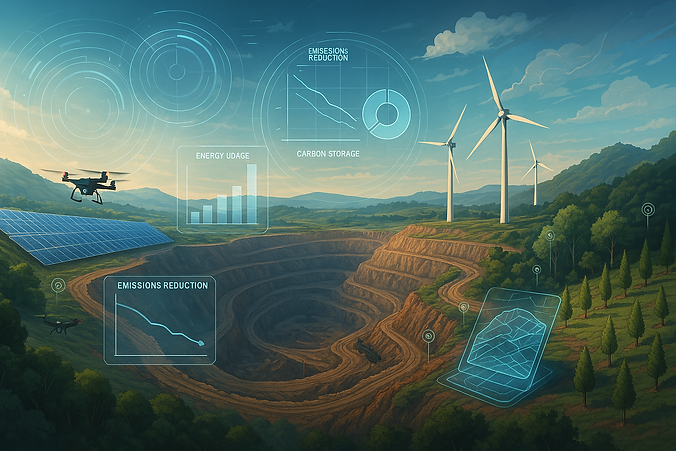
Accelerating Decarbonisation targets Through Data Innovation in Mining
As the mining industry continues to pursue ambitious goals toward decarbonisation, I led a strategic project that explored how data could drive actionable insights and measurable progress on this journey. The initiative began from the ground up, starting with workshops and ideation sessions, then moving through opportunity framing, problem scoping, solution exploration, and early risk identification.
The Approach
Our vision was clear: to accelerate decarbonisation by making better use of both existing and emerging data and digital capabilities. We set out to understand how data, when properly curated, standardised, and shared, could go beyond reporting and monitoring. The aim was to enable forward-looking applications such as simulation, prediction, and optimisation of emissions and energy use.


Next Steps
Monitoring and Predicting Energy Consumption and Carbon Emissions
-
Operations needed a central dashboard to visualise and simulate energy use and emissions, bringing together digital operational planning tools and live data feeds.
-
A key priority was connecting data from multiple sites and aligning it with the company’s broader roadmap toward carbon neutrality.
Developing a Digital Twin for Carbon Management
-
We proposed developing a simplified 2D model enriched with 3D geoscientific data to simulate and calculate carbon storage volumes, focusing on methods such as afforestation and mineralisation.
-
The work involved studying soil and rock properties, using sensor data, and comparing aerial and sample-based approaches to measure carbon and methane levels.
Supporting Methane Capture and Safety Operations
-
We worked closely with teams specialising in regenerative thermal oxidation to help reduce methane emissions.
-
Our goal was to strengthen safety, integrity, and emissions control by using predictive data tools.
Strategic Approach
Our approach brought together several key areas of work:
-
Data exploration and governance: We partnered with internal teams focused on data governance and accessibility to ensure information was standardised, reliable, and easy to use.
-
Technology mapping: We identified suitable tools and platforms for data analysis, including dashboards, simulation systems, and geospatial mapping services.
-
Prototyping and use case development: We created scalable models for visualisation, planning, and forecasting, designed to suit the unique geographic and environmental conditions of each site.
-
Risk and assumption analysis: We identified gaps in data availability, such as missing land use information, integration challenges, and the need for stronger collaboration between digital, geoscience, and sustainability teams.
Impact and Outlook
By grounding the project in real operational challenges and using data analysis effectively, this initiative set the foundation for digital solutions that can accelerate progress toward carbon neutrality. It also highlighted the importance of collaboration across different teams to achieve meaningful environmental outcomes through data driven strategies.
This project reflects the kind of work I lead, strategically connecting user needs, emerging technologies, and organisational goals to deliver scalable and measurable solutions in complex environments.